
Free Cybersecurity Certifications You Can Earn Online in 2026
Cybersecurity is no longer a niche career reserved for highly experienced IT professionals.
As businesses move more of their operations online, organizations need people who understand network security, ethical hacking, vulnerability management, security operations, cloud security, incident response and cyber risk.
The good news is that you don’t necessarily need to spend thousands of rupees to start learning.
There are several free cybersecurity courses, certificates, digital badges and entry-level credentials available online from organizations such as Cisco, IBM, Fortinet, The Open University, TryHackMe, EC-Council and others.
However, there is one important thing to understand:
A free certificate can prove that you completed a course, but it does not automatically make you job-ready.
A strong cybersecurity career requires a combination of:
Knowledge + Practical Skills + Projects + Certifications + Practice + Career Preparation
In this guide, we’ll look at 10 free cybersecurity certification and certificate opportunities you can explore online in 2026, who they are suitable for, what you’ll learn, and how you can use them as part of your cybersecurity career journey.
First: What Is the Difference Between a Cybersecurity Certificate and Certification?
Before choosing a program, understand this distinction.
Certificate
A certificate generally proves that you completed a course or learning program.
For example:
Complete a cybersecurity course → Pass the course requirements → Receive a certificate of completion.
It demonstrates learning and commitment.
Certification
A professional certification generally validates knowledge or skills against a defined standard, often through an assessment or examination.
For example:
Prepare → Take an examination/assessment → Meet certification requirements → Earn a professional certification.
This distinction matters when you’re building your resume.
Some of the options below are professional certifications, while others are course certificates, digital badges or completion credentials.
That’s why you should always check what credential the provider actually awards.
1. Fortinet NSE 1 – Cybersecurity
Best for: Beginners and students
Cost: Free
Level: Beginner
Provider: Fortinet
If you’re completely new to cybersecurity, Fortinet’s NSE 1 is one of the options worth considering.
Fortinet’s current NSE program was updated in July 2026. NSE 1 is now an entry-level cybersecurity credential, and Fortinet says its NSE 1-3 training is available online and free of charge.
The current NSE 1 requirements include completing the online Cybersecurity and Cloud Fundamentals course.

What can you learn?
Depending on the current course version, beginner topics include:
- Cybersecurity fundamentals
- Cyber threats
- Security concepts
- Information protection
- Basic security practices
- Cloud fundamentals
Why is it useful?
It’s a good starting point if you don’t yet understand basic cybersecurity terminology.
It can help you answer questions such as:
- What is a cyberattack?
- What is malware?
- What is phishing?
- Why is identity security important?
- How do organizations protect information?
Best suited for: Students, beginners and people moving from general IT into cybersecurity.
2. Cisco Introduction to Cybersecurity
Best for: Absolute beginners
Cost: Free
Duration: Around 6 hours
Provider: Cisco Networking Academy
Cisco Networking Academy offers free self-paced courses, including Introduction to Cybersecurity. Cisco describes the course as a beginner-level introduction to cybersecurity and its relevance as a career.
The course explores:
- Cybersecurity threats
- Online safety
- Data protection
- Privacy
- Cybersecurity careers
- Common security concepts
Cisco’s course documentation says successful completion is associated with a digital badge.

Cisco also states that its digital badges are free and designed to verify skills gained through coursework.
Why should beginners take it?
If you’re searching for:
“free cybersecurity course for beginners”
this is one of the easiest places to start.
You don’t need advanced networking knowledge before beginning.
3. IBM SkillsBuild Cybersecurity Fundamentals
Best for: Students and beginner-to-intermediate learners
Cost: Free
Credential: Digital credential/badge
Provider: IBM SkillsBuild
IBM SkillsBuild provides several free learning opportunities, including Cybersecurity Fundamentals.
The credential covers areas such as:
- Cybersecurity concepts
- Cyberattacks
- Social engineering
- Cryptography
- Threat analysis
- Incident response
- Vulnerability management
- Security strategies
- Cybersecurity risk management

IBM states that learners can earn the credential by completing the Cybersecurity Fundamentals learning experience and passing the end-of-course assessment with at least 80%. The credential is available to registered IBM SkillsBuild users.
Why is this interesting?
It’s more than simply watching introductory videos.
The curriculum introduces concepts that connect directly to real cybersecurity roles.
If you’re interested in becoming a:
- SOC Analyst
- Cybersecurity Analyst
- Security Operations professional
- Threat Analyst
this type of foundational learning can be a useful starting point.
4. Cisco Cybersecurity Essentials
Best for: Learners who already know basic IT concepts
Cost: Free learning option
Credential: Digital badge
Provider: Cisco Networking Academy
If Cisco’s Introduction to Cybersecurity feels too basic, the next step can be Cybersecurity Essentials.
Cisco describes the course as covering foundational cybersecurity knowledge across areas including:
- Information security
- Systems security
- Network security
- Security ethics and laws
- Defense and mitigation
Cisco course documentation also identifies a digital badge as a course recognition.
Why take it?
This is a better option for learners who want to move from:
“I know what cybersecurity is.”
to:
“I understand some of the major cybersecurity domains.”
It can also help you decide which specialization interests you most.
5. OpenLearn – Introduction to Cyber Security: Stay Safe Online
Best for: Complete beginners
Cost: Free
Provider: The Open University
The Open University offers a free course called:
Introduction to cyber security: stay safe online
The course covers concepts including:
- Malware
- Viruses
- Trojans
- Network security
- Cryptography
- Identity theft
- Risk management
- Online security
The course was updated in March 2026 and offers a free Statement of Participation. Learners can also earn a free Open University digital badge by completing the required activities and quizzes.

One important point
The Open University explicitly explains that its badge is not an accredited university qualification.
That’s perfectly fine.
A beginner credential doesn’t have to be a professional certification to be useful.
It can demonstrate:
“I started learning cybersecurity and completed structured training.”
6. TryHackMe – Pre Security Path
Best for: Beginners who want practical cybersecurity exposure
Cost: Free content is available, but availability of individual content can change
Credential: Certificate of completion for the learning path
Platform: TryHackMe
If you’re interested in learning by doing, TryHackMe is worth exploring.
Its Pre Security learning path is designed to introduce learners to:
- Computer fundamentals
- Networking
- Web basics
- Programming fundamentals
- Cybersecurity concepts
- Attacker and defender thinking
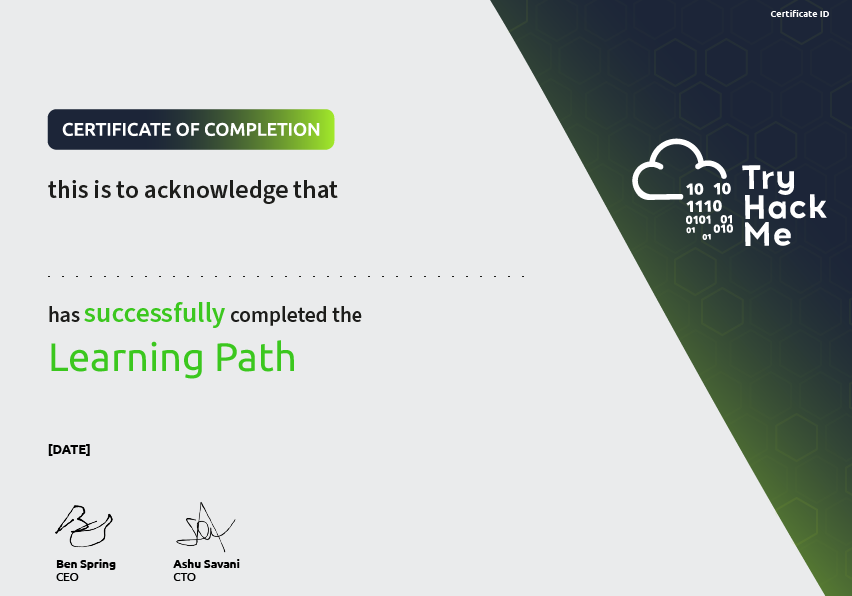
TryHackMe’s current 2026 Pre Security path states that completing the learning path can earn a certificate of completion.
TryHackMe also currently offers a large collection of free rooms covering areas such as networking, web security, Active Directory, malware, forensics and more.
Why this matters
Cybersecurity isn’t something you can master by watching videos alone.
You need to practice.
That’s why platforms with hands-on environments can complement traditional certifications.
7. Simplilearn SkillUp – Introduction to Cyber Security
Best for: Beginners
Cost: Free
Credential: Completion certificate
Provider: Simplilearn SkillUp
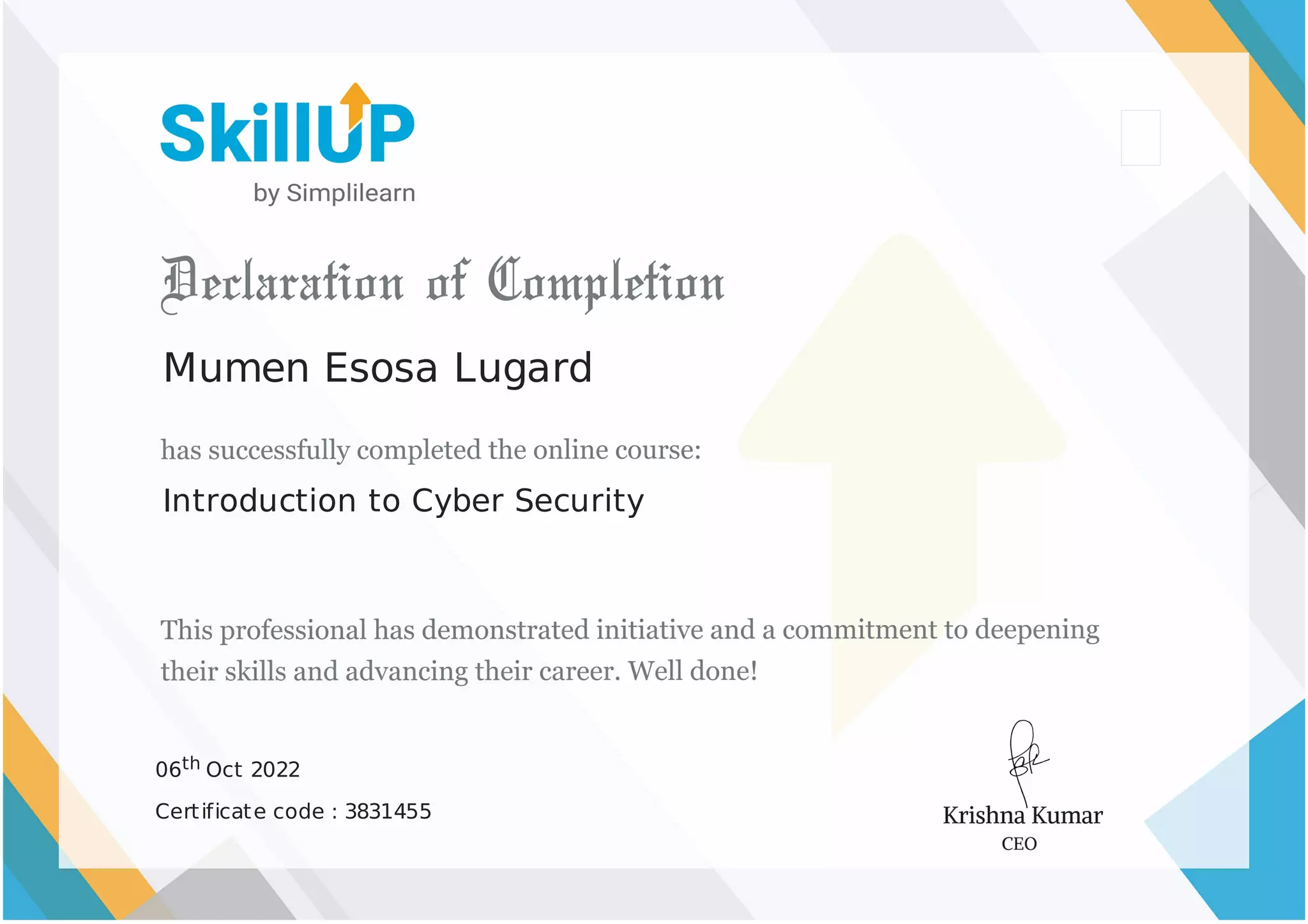
Simplilearn’s SkillUp platform currently offers free cybersecurity courses with completion certificates.
Its Introduction to Cyber Security course covers fundamentals such as:
- Cyber threats
- Security practices
- Risk management
- Security policies
- Wireless security
- BYOD security
The current course listing states that it is self-paced and includes a completion certificate.
Why consider it?
It’s useful if you want a short introductory course that you can complete relatively quickly.
For a beginner, completing a short course can also help you determine whether cybersecurity is genuinely interesting to you before investing in longer programs.
8. Simplilearn SkillUp – Ethical Hacking Basics
Best for: Beginners interested in ethical hacking
Cost: Free
Credential: Completion certificate
If you’ve ever searched:
“How do hackers hack websites?”
or
“How do I become an ethical hacker?”
you’ve probably encountered the term ethical hacking.
Simplilearn’s SkillUp currently offers an Ethical Hacking Basics course with free enrollment and a completion certificate. The course introduces topics such as hacking techniques, security tools and cryptography.
What should you understand first?
Ethical hacking is not about breaking into random accounts.
Professional ethical hacking means:
Testing systems with authorization to identify vulnerabilities before malicious attackers exploit them.
That distinction is fundamental.
If ethical hacking interests you, this type of introductory course can be a starting point before moving into more practical VAPT and penetration-testing training.
9. EC-Council Learning – Free Cybersecurity Courses
Best for: Learners who want exposure to multiple cybersecurity topics
Cost: Free account and free courses
Credential: Course completion validation for eligible courses
Provider: EC-Council
EC-Council is widely associated with its Certified Ethical Hacker ecosystem, but it also provides a free learning platform.
Its current EC-Council Learning platform says learners can create a free account and access 25+ complete cybersecurity and IT courses.

The platform also states that learners receive a validation of course completion after completing eligible courses.
Topics available across its free learning ecosystem can include areas such as:
- Ethical hacking
- Threat intelligence
- Cybersecurity fundamentals
- Security operations
- Digital security
- Cyber defense
Who should use it?
It’s useful for someone who wants to explore different cybersecurity domains before deciding on a specialization.
10. ISC2 Certified in Cybersecurity – CC
Best for: Entry-level cybersecurity professionals
Credential type: Professional certification
Important: New free-program enrollment has ended.
This one requires an important clarification.
The ISC2 Certified in Cybersecurity (CC) is a genuine entry-level professional certification—not simply a course completion certificate.
ISC2 describes CC as an entry-level certification that requires no prior work experience and validates foundational knowledge across areas such as:
- Security principles
- Business continuity and disaster recovery concepts
- Access controls
- Network security
- Security operations


ISC2 also identifies it as suitable for college students, recent graduates, IT professionals and career changers.
However, ISC2’s One Million Certified in Cybersecurity program has ended new enrollment. More than one million people enrolled during the program, and ISC2 closed new enrollments on May 20, 2026. People who already received a valid free exam code may still use it according to ISC2’s stated deadlines.
So can you get CC for free today?
Not through the former One Million Certified in Cybersecurity enrollment program.
This is important because many older blogs still claim:
“Get ISC2 CC completely free.”
That information is now outdated.
If you already received a valid code, check your ISC2 account and the applicable expiration date.
For everyone else, CC remains a valuable entry-level professional certification, but you should check the current ISC2 pricing and candidate options.
Bonus: Other Free Cybersecurity Learning Platforms Worth Exploring
The 10 options above aren’t the only places where you can learn cybersecurity for free.
You can also explore:
Palo Alto Networks Cybersecurity Academy
Palo Alto Networks currently offers free online cybersecurity courses for students and job seekers, including AI in Cybersecurity Fundamentals, Cybersecurity Fundamentals and Network Security Fundamentals.
Google Cloud / Mandiant Academy
Google Cloud currently provides several free Mandiant Academy courses, including:
- What is Cyber Defense?
- Intelligence is the Guiding Light
- Hunting for Active Threats
- Detecting and Investigating Malicious Activity
These are useful for people interested in cyber defense and threat intelligence.
Google Cloud Cybersecurity Certificate
Google Cloud also offers a Cybersecurity Certificate designed for entry-level cloud cybersecurity roles. However, it is not generally a free certificate: Google currently lists the standard learning subscription at $29/month, while no-cost access is available through specific Career Launchpad eligibility.
This is another example of why you should always check the provider’s current pricing before calling something a “free certification.”
Which Free Cybersecurity Certification Should You Choose?
Don’t choose a certification simply because it has the word FREE in its title.
Choose according to your career stage.
| Your Goal | Recommended Starting Point |
|---|---|
| Complete beginner | Cisco Introduction to Cybersecurity |
| Learn basic security concepts | Fortinet NSE 1 |
| Build foundational knowledge | IBM Cybersecurity Fundamentals |
| Learn online safety + security | OpenLearn Introduction to Cyber Security |
| Learn practical cybersecurity | TryHackMe |
| Explore ethical hacking | Simplilearn Ethical Hacking Basics |
| Explore multiple cybersecurity topics | EC-Council Learning |
| Build Cisco security knowledge | Cisco Cybersecurity Essentials |
| Earn a professional entry-level certification | ISC2 CC |
| Explore cyber defense | Mandiant Academy |
Are Free Cybersecurity Certifications Worth It?
Yes-but don’t expect a certificate alone to get you a job.
This is one of the biggest mistakes beginners make.
A learner completes a two-hour course and adds:
Cybersecurity Certified
to their LinkedIn profile.
Then they expect recruiters to immediately start calling.
Cybersecurity doesn’t work that way.
A certificate is evidence of learning.
It isn’t proof that you can independently investigate a security incident, perform a VAPT assessment, analyze SIEM alerts or secure a cloud environment.
For a stronger cybersecurity profile, build this combination:
1. Fundamentals
Learn:
- Networking
- Linux
- Windows
- Security concepts
- Authentication
- Cryptography
- Web fundamentals
2. Certification
Earn relevant credentials.
3. Practical Skills
Practice:
- VAPT
- SOC analysis
- Threat hunting
- Digital forensics
- Incident response
- Cloud security
4. Projects
Build projects such as:
- Vulnerability assessment reports
- SOC monitoring dashboards
- Threat intelligence investigations
- Phishing analysis
- Security automation
- Home labs
5. Portfolio
Document what you have actually done.
6. Career Preparation
Work on:
- Resume
- Interview skills
- Communication
- Technical assessments
This is the difference between:
“I have a certificate.”
and
“I can demonstrate cybersecurity skills.”
Free Certificate vs Professional Certification: Which Is Better?
Neither is automatically “better.”
It depends on your objective.
If you’re a complete beginner:
Start with free courses and certificates.
If you already understand cybersecurity:
Move toward professional certifications.
If you’re applying for jobs:
Combine certifications with projects and hands-on practice.
If you’re a student:
Build your profile gradually.
Learn → Practice → Certify → Build → Apply
How Many Cybersecurity Certifications Do You Need?
You don’t need 20 certificates.
In fact, collecting certificates without developing skills can hurt your credibility.
Imagine two candidates.
Candidate A
Has:
17 certificates
but cannot explain:
- TCP/IP
- DNS
- HTTP
- Authentication
- SIEM
- OWASP
Candidate B
Has:
3 relevant credentials
and has completed:
- A VAPT project
- A SOC lab
- A threat investigation
- A GitHub security portfolio
Candidate B may have a much stronger story.
The goal shouldn’t be:
Collect certificates.
The goal should be:
Build capability.
How to Start Your Cybersecurity Career in 2026
If you’re starting from zero, don’t try to learn everything simultaneously.
Follow a structured path.
Step 1 – Learn IT Fundamentals
Understand:
- Operating systems
- Networking
- Linux
- Windows
- Basic scripting
Step 2 – Learn Cybersecurity Fundamentals
Understand:
- CIA Triad
- Threats
- Vulnerabilities
- Risk
- Authentication
- Authorization
- Encryption
- Malware
- Phishing
Step 3 – Choose a Specialization
You could explore:
Ethical Hacking / VAPT
Find and validate security vulnerabilities.
SOC
Monitor and investigate security events.
Digital Forensics
Investigate digital evidence.
Cloud Security
Protect cloud infrastructure and workloads.
GRC
Manage governance, risk and compliance.
AI Security
Secure AI applications, models and AI agents.
Step 4 – Practice
Use legitimate labs and CTF environments.
Step 5 – Build Projects
Don’t just watch tutorials.
Build.
Step 6 – Earn Relevant Credentials
Choose certifications based on your desired role.
Step 7 — Build Your Portfolio
Show employers what you can actually do.
What About Free Cybersecurity Certifications from Ernith?
This is where the cybersecurity learning ecosystem is changing.
Many learners can find individual courses and certificates online, but the bigger challenge is putting everything together:
Learning → Practice → Assessment → Certification → Portfolio → Career
That’s one of the ideas behind Ernith.
Meet Ernith: A New Cybersecurity Learning & Career Ecosystem
Ernith is being developed with a simple goal:
Make cybersecurity learning more practical, accessible and career-focused.
Instead of treating cybersecurity education as simply watching videos and collecting certificates, Ernith is designed around a broader journey.
Learn.
Build cybersecurity knowledge.
Practice.
Test your understanding through practical challenges and security-focused activities.
Certify.
Demonstrate what you’ve learned through assessments and credentials.
Build.
Develop a stronger cybersecurity profile and portfolio.
Get Hired.
Move toward internships, jobs and career opportunities.
This is the difference between:
Learning cybersecurity
and
Building a cybersecurity career.
Explore Ernith: Ernith — Cybersecurity Learning & Career Platform
Why Ernith Matters for Cybersecurity Students
Imagine a student searching Google for:
“Free cybersecurity certification”
They find a course.
Complete it.
Download a certificate.
And then ask:
“What should I do next?”
That’s the problem Ernith aims to solve.
A cybersecurity learner shouldn’t have to search for ten different platforms to find:
- Learning resources
- Practical challenges
- Cybersecurity assessments
- Certifications
- Career guidance
- Resume support
- Opportunities
The long-term vision is to bring these pieces closer together.
Learn More Than a Certificate
A certificate can open the door.
Skills help you walk through it.
That’s why cybersecurity learners should build a profile that demonstrates:
Knowledge
You understand cybersecurity concepts.
Practice
You’ve worked with realistic security scenarios.
Problem Solving
You can investigate and analyze security problems.
Communication
You can explain your findings.
Portfolio
You can show evidence of your work.
Credentials
You have recognized learning achievements.
This combination is far more valuable than simply collecting certificates.
TriosCyber + Ernith: From Training to Career Development
For learners who want structured cybersecurity education, TriosCyber provides cybersecurity training and professional development across areas such as ethical hacking, VAPT, SOC, cloud security, AI security and other cybersecurity domains.
The goal isn’t simply to teach students what a vulnerability is.
It’s to help learners understand:
How attacks happen → How vulnerabilities are identified → How systems are defended → How security operations work → How cybersecurity skills are applied professionally.
TriosCyber’s cybersecurity training can therefore complement the self-paced learning available through platforms listed in this article.
Explore TriosCyber: TriosCyber — Cybersecurity Training & Services
Free Doesn’t Mean Easy
There’s a misconception that if something is free, it should be easy.
Cybersecurity is the opposite.
The learning resources may be free.
The skill development isn’t.
You still need to invest:
- Time
- Practice
- Discipline
- Curiosity
- Problem-solving
- Consistency
You may be able to earn your first certificate in a few hours.
But becoming genuinely good at cybersecurity can take months or years.
That’s normal.
How to Put a Free Cybersecurity Certificate on Your Resume
Don’t simply write:
Cybersecurity Certificate – 2026
Give the recruiter context.
For example:
IBM SkillsBuild – Cybersecurity Fundamentals
Completed foundational training covering cyber threats, cryptography, incident response, vulnerability management and cybersecurity risk management.
Or:
Cisco Networking Academy – Introduction to Cybersecurity
Completed foundational cybersecurity training covering cyber threats, online safety, data protection and cybersecurity career fundamentals.
This makes your achievement more meaningful.
How to Add Cybersecurity Credentials to LinkedIn
If the provider gives you a verifiable digital badge, add it to your LinkedIn profile.
Include:
Credential Name
Issuing Organization
Issue Date
Credential ID — if provided
Credential URL — if provided
Avoid adding a course certificate as though it were a professional certification.
For example:
❌ Certified Ethical Hacker
if you only completed a beginner ethical-hacking course.
Better:
✅ Ethical Hacking Basics — Course Completion Certificate
Being accurate builds trust.
Free Cybersecurity Certifications: Frequently Asked Questions
Are free cybersecurity certifications worth it?
Yes. They can help beginners build foundational knowledge and demonstrate initiative. However, a certificate alone does not guarantee employment. Combine credentials with practical skills, projects and a strong portfolio.
Can I get a cybersecurity certification completely free?
Some credentials are available without a fee, while others offer free training but charge for the final certification exam. Always check the provider’s current terms.
For example, Fortinet’s NSE 1–3 training is currently free, while ISC2’s former free CC enrollment program has ended for new participants.
What is the best free cybersecurity certification for beginners?
There is no single best option for everyone. Cisco Introduction to Cybersecurity, Fortinet NSE 1 and IBM Cybersecurity Fundamentals are strong starting points for beginners.
Can I get a cybersecurity job with a free certificate?
A certificate can help demonstrate learning, but employers typically evaluate a combination of knowledge, practical skills, projects, communication and relevant experience.
Which cybersecurity certification should I get first?
If you’re completely new, begin with foundational training. Once you understand networking, operating systems and cybersecurity fundamentals, choose a certification aligned with your target role.
Are free cybersecurity certificates recognized by employers?
Recognition varies. A digital badge or course certificate from a known organization can demonstrate learning, but it should not automatically be treated as equivalent to a professional certification.
Can students earn cybersecurity certificates online?
Yes. Many providers offer beginner-friendly online learning options. Cisco, IBM, Fortinet, OpenLearn and other platforms have resources suitable for students.
Can I learn ethical hacking for free?
Yes. There are free introductory ethical-hacking courses and practice resources. However, professional penetration testing requires significantly more knowledge and hands-on experience than a short introductory course.
Is a cybersecurity certificate enough to become an ethical hacker?
No. Ethical hacking requires knowledge of networking, operating systems, web applications, vulnerabilities, security tools, scripting and responsible testing methodology. A beginner certificate is only a starting point.
Is Ernith a cybersecurity certification?
Ernith is being positioned as a broader cybersecurity learning, practice, certification and career ecosystem, rather than simply another standalone certificate.
Final Thoughts
The biggest mistake a beginner can make is thinking:
“I need to buy an expensive certification before I can start cybersecurity.”
You don’t.
You can start today.
You can learn the fundamentals.
You can complete free courses.
You can earn digital badges and certificates.
You can practice in legitimate labs.
You can build projects.
You can create a portfolio.
And then you can decide which professional certification makes sense for your career.
The important thing is to avoid becoming a certificate collector.
Instead, become a skill builder.
Remember:
And if you’re looking for a platform designed around that broader cybersecurity journey, keep an eye on Ernith.
Your cybersecurity career doesn’t start with a certificate.
It starts with the decision to learn.
🚀 Start Your Cybersecurity Journey
Want structured cybersecurity training?
Explore TriosCyber for professional cybersecurity education, practical training and cybersecurity services. Explore TriosCyber
Want to learn, practice and build your cybersecurity career?
Explore Ernith and follow the next generation of cybersecurity learning.